Beyond the 5.9%: What is new in the 2027 FedEx general rate increase (GRI)?
,
Sep 18, 2026
.
5 minutes to read
As shippers finalize their budgets for the coming year, FedEx has once again set the market tone by being the first major carrier to announce its annual General Rate Increase (GRI). The headline average will look familiar to anyone who has sat through the last three announcements. What sits underneath it will not.
The 2027 GRI is the most structurally different increase FedEx has published since 2023. The long-haul penalties and middle-weight pressure that defined last year have been set aside. In their place is a Ground table that is nearly flat across every zone, an Express table that is anything but, a minimum charge that keeps climbing faster than base rates, and another round of accessorial increases that outrun the headline.
In this article, we deconstruct the 2027 FedEx GRI, moving past the headline number to show where shippers will actually feel the pressure. We also look at how the right combination of AI-powered data analysis and deep industry expertise can help your organization navigate a parcel market that changes faster every year.
Structural Change the Key to 2027 FedEx GRI
Effective January 4, 2027, FedEx will implement its annual rate adjustments across Express, Ground, and Freight services. For the fourth consecutive year, the carrier has announced an average rate increase of 5.9% for its U.S. domestic and international package services.
Four years at the same number reads like stability, but the backdrop has moved underneath it. Inflation is now trending around 3.4%, up from roughly 2.9% when we wrote about the 2026 GRI. FedEx held its headline flat while the cost environment it cites as justification rose, which narrowed the gap between the GRI and inflation from three points to about two and a half. That is worth naming in a negotiation. The carrier has been running the same number regardless of whether inflation was 2.9% or 3.4%, which says the 5.9% is a yield target rather than a cost pass-through.
What makes 2027 different is not the size of the increase. It is the shape. Five of the seven major services land above the 5.9% average, ranging from 6.01% on First Overnight to 6.65% on 2Day A.M. Standard Overnight comes in under at 5.16%, and Express Saver lands all the way down at 3.09%. That single carve-out is what pulls the blend back to 5.9%, which means most shippers will land above the announced number once their own service mix is applied.
Here are the key takeaways from the announcement:
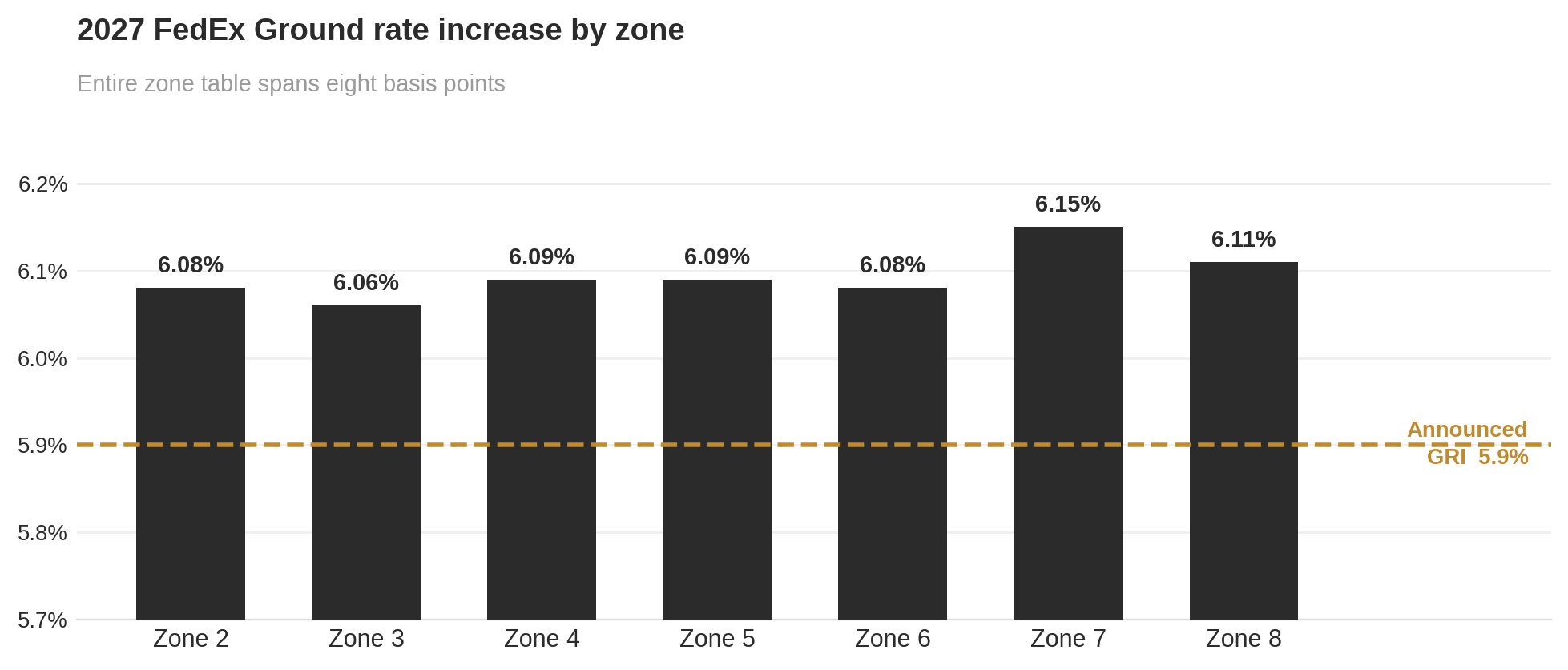
FedEx Ground increases are nearly uniform across every zone, reversing two years of long-haul targeting
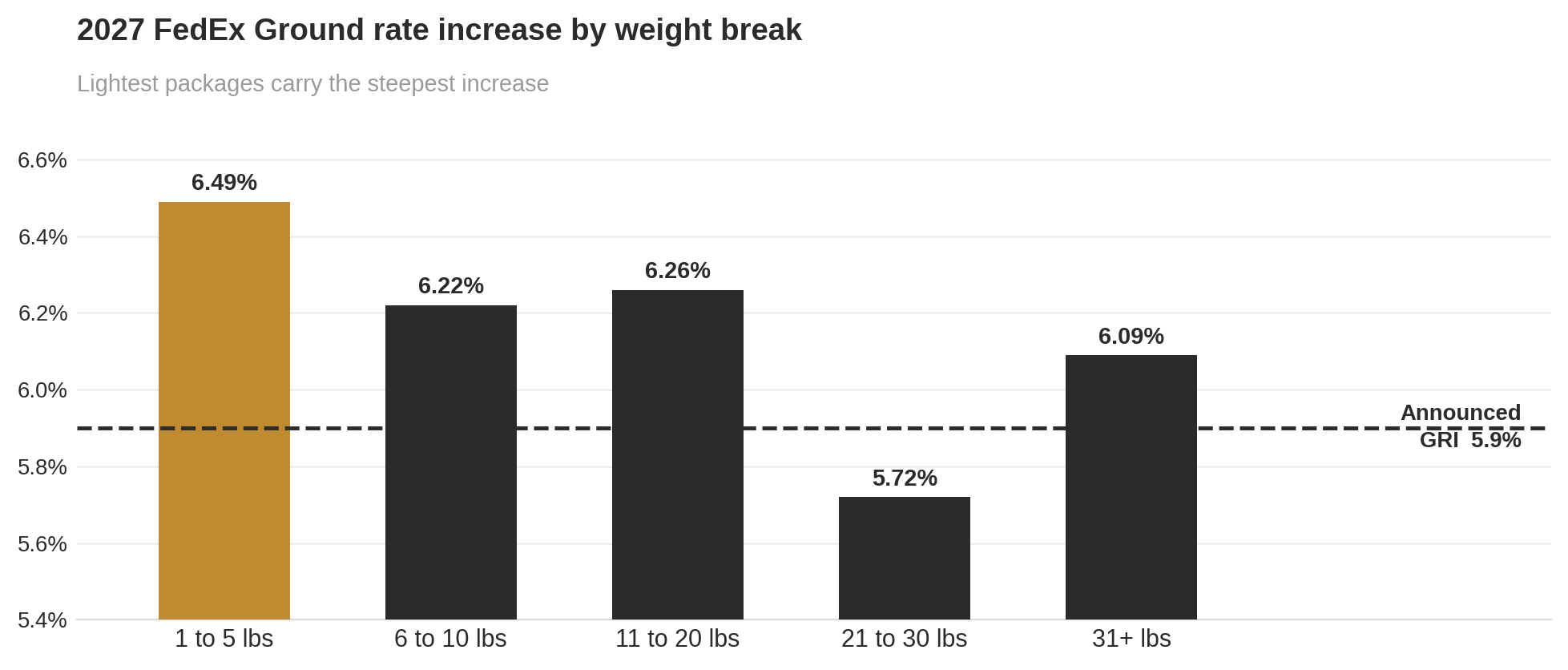
The weight pressure moved from the middle of the curve to the light end, with 1 to 5 lb Ground taking the steepest increase at 6.49%
Express Saver was held to roughly half the increase of every other service, a deliberate competitive move
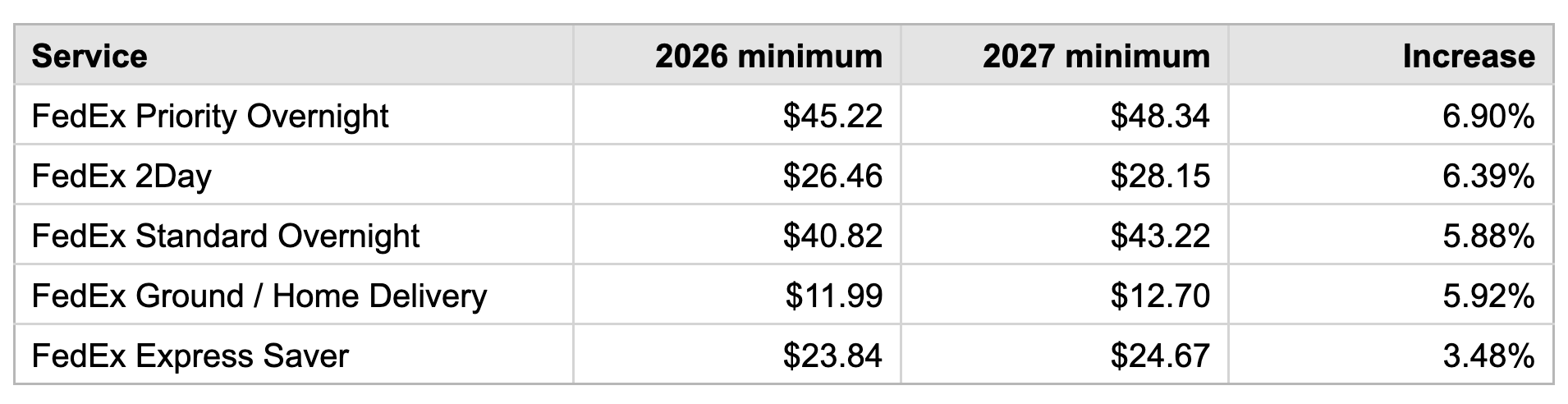
The FedEx Ground minimum charge rises to $12.70, up 5.92%, and four of five service minimums are climbing faster than their own base rates
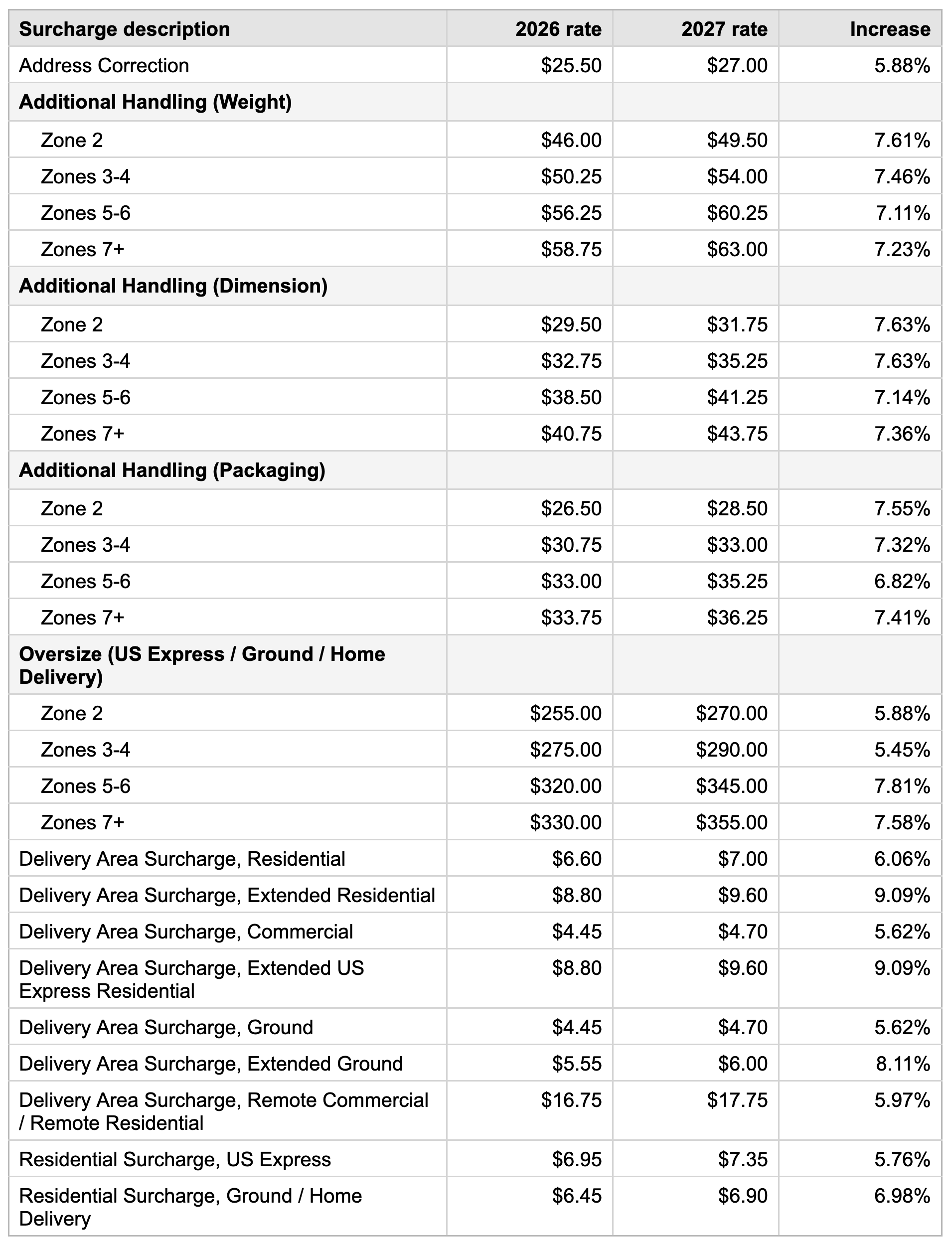
Additional Handling normalized at a uniform 7.1% to 7.6% across all zones and all three triggers, well above base rates
Extended Delivery Area Surcharges jumped 8% to 9%, the fastest-moving line items in the entire accessorial table
Analyzing Five Impactful Hidden Costs in the 2027 GRI
The strategic complexity of the 2027 GRI shows up as soon as you compare the published tables year over year. FedEx is not applying a simple across-the-board increase. It is running a surgical pricing approach that protects certain services and shipment profiles while pressuring others, and the targets moved from where they were twelve months ago.
That shift is the reason a granular understanding of your own shipping data matters more this cycle than last. The changes below will hit two shippers with the same annual spend very differently.
1. Ground flattens to a uniform 6.1% across every zone
For two years running, FedEx loaded its Ground increases into Zones 7 and 8, where regional competition thins out and cost to serve climbs. In 2026 those zones came in at 6.17% and 6.16% against a 5.9% average, and heavier long-haul shipments saw two-year increases well past 40%.
That did not happen this year. The 2027 Ground increases run 6.08% in Zone 2, 6.09% in Zone 5, 6.15% in Zone 7, and 6.11% in Zone 8. From the lowest zone to the highest, the entire table spans eight basis points.
Figure 1: 2027 FedEx Ground rate increase by zone
This changes how you approach the carrier. Shippers who spent last cycle building a zone-specific case for long-haul relief will find that argument has less to grab onto. When the increase is uniform, the counter has to be uniform as well: base discount improvement across the full zone table, or a change in how earned discounts are structured, rather than surgical asks on a handful of lanes.
It also raises a question worth putting to your FedEx rep directly. A flat increase across the zone table usually means the carrier is defending share somewhere. Regional carriers have been taking short-zone Ground volume for three years now, and this reads as a response to that.
2. Light-package squeeze pushes 1 to 5 lb Ground to 6.49%
Last year FedEx applied above-average increases to the 11 to 20 lb bracket, a classic yield play in a range where regional competition is weaker. For 2027 the pressure moved down the curve to the packages that make up the bulk of e-commerce volume.
FedEx Ground by weight break now runs 6.49% at 1 to 5 lbs, 6.22% at 6 to 10 lbs, 6.26% at 11 to 20 lbs, 5.72% at 21 to 30 lbs, and 6.09% above 31 lbs. The lightest packages carry the steepest increase and the 21 to 30 lb bracket got the smallest.
Figure 2: 2027 FedEx Ground percent increase by weight break
For shippers with a light, high-count profile, this compounds directly with the minimum charge increase covered below. Both changes land on the same packages, and neither one shows up in the headline.
3. Express Saver held to 3.1%, roughly half of every other service
Express Saver came in at 3.09% by zone and 3.25% by weight, with a minimum charge increase of just 3.48%. Every other service minimum in the table moved between 5.88% and 6.90%.
FedEx does not leave three points of yield on the table by accident. This is a defensive move, and it points at one of two things: protecting deferred air volume from trading down into Ground, or answering pressure from UPS 3 Day Select and other deferred products in the market.
Either way it creates an opening. Shippers with transit-tolerant freight currently moving on 2Day should model the Express Saver alternative before their next renewal. The gap between the two services widened by more than three points this year, and gaps that size tend to close in the following GRI.
4. Minimum charge increases up to 6.9%
For 2027, the FedEx Ground minimum charge rises from $11.99 to $12.70. That is the second consecutive year of roughly 5.9%, and it takes the Ground floor from $11.32 to $12.70 in two years, a compounded 12.2%.
Figure 3: FedEx minimum net charge increases, 2026 to 2027
Four of five minimums are rising faster than the base rates on the same service. Standard Overnight is the clearest case: base rates up 5.16%, floor up 5.88%.
The minimum charge is the lowest amount a shipper can pay regardless of any negotiated discount. For lightweight, short-zone shipments it is not a floor you occasionally touch, it is the rate you actually pay on a meaningful share of your volume. Every point of minimum increase erases a point of discount on those packages, and no amount of base rate concession fixes it. A minimum charge reduction has to be negotiated on its own terms.
5. Additional Handling normalizes at 7.6% and extended DAS jumps 9.1%
The last two GRIs moved accessorials in fits and starts. Oversize jumped 22% to 33% in 2026. Additional Handling in Zones 5 and 6 went up 11% to 13% while Zone 2 moved less than 6%. For 2027, FedEx smoothed all of that out and reset it at a level above base rates.
Figure 4: Summary of common surcharge increases, 2026 to 2027
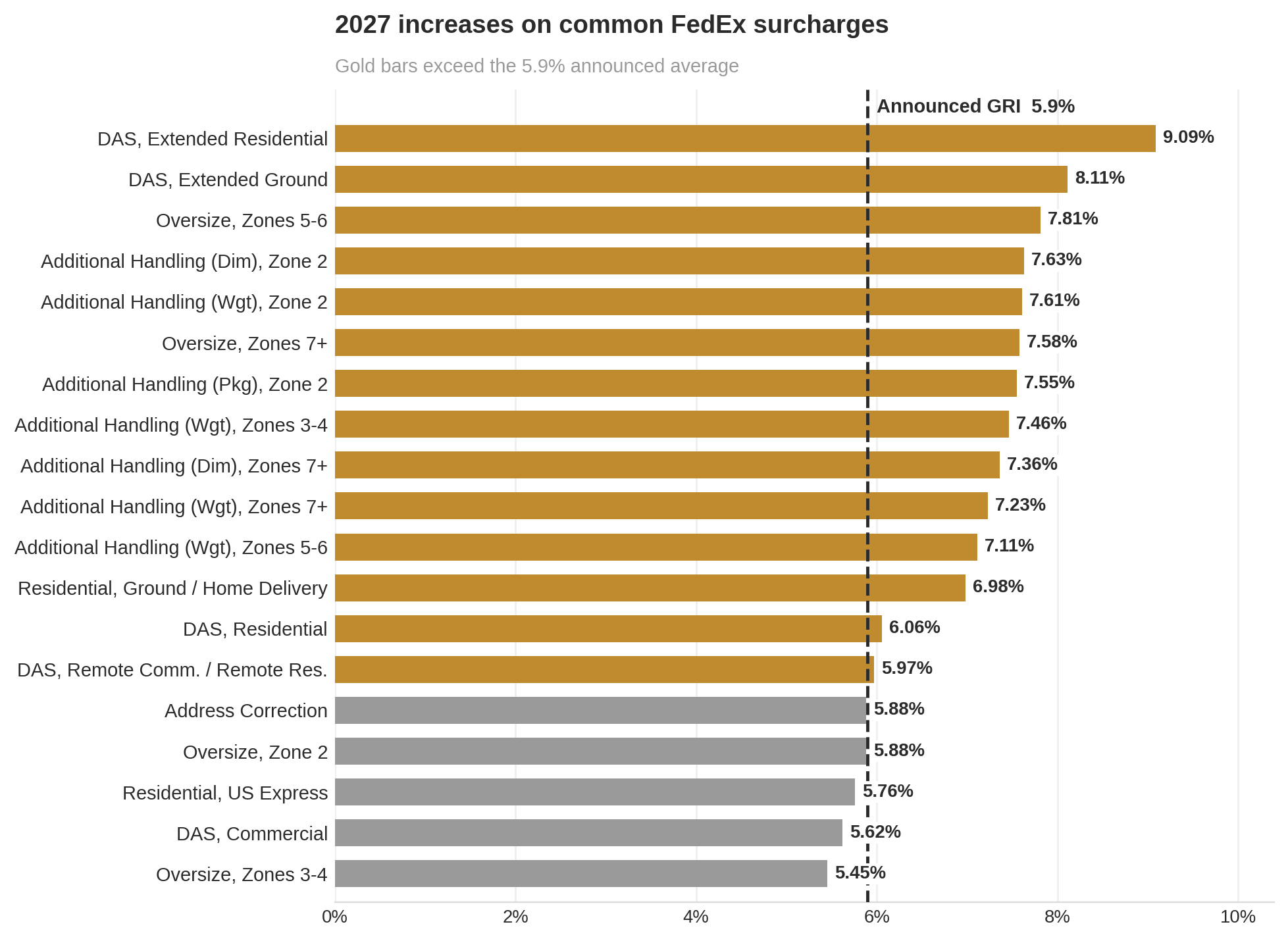
Two patterns stand out. Additional Handling is now a flat 7% to 7.6% no matter which trigger fires or which zone the package moves in, which suggests FedEx finished re-basing that surcharge last year and is now escalating it as a single block. And the extended DAS tiers, at 9.09% and 8.11%, are climbing at roughly 1.5 times the base rate increase. Rural residential delivery is where FedEx is pricing hardest in 2027.
Figure 5: 2027 percentage increase on common FedEx surcharges
Keep in mind that most accessorial discounts are written as a percentage off published rates. When the published rate climbs 7.6% and your discount percentage stays flat, your cost climbs 7.6% right along with it. These fees also stack on top of base rates and on each other, and because many are subject to fuel, their effect on the final invoice is larger than the table alone suggests. Dollar-capped or fixed-rate accessorial terms are the only structure that holds up under this pattern, and they are the terms carriers resist most.
6. BONUS: Middle-zone Express pricing runs as high as 7.9%
Ground went flat this year. Express did the opposite. FedEx 2Day A.M. increases run 7.87%, 7.86%, and 7.88% in Zones 3, 4, and 5, then drop to between 5.57% and 5.89% in Zones 6, 7, and 8. Standard Overnight sits near 4.9% almost everywhere but spikes to 6.57% in Zone 3.
Middle-zone two-day air is the single most expensive place to be in the 2027 table. If your Express profile concentrates in Zones 3 through 5, your effective increase will run well past the headline no matter how good your discounts look on paper. This is also the kind of variance that never appears in a carrier-provided impact summary, because averaging it against the long zones makes it disappear.
Turn Your Data into a Competitive Advantage
The 2027 FedEx General Rate Increase is another exercise in strategic pricing, where a familiar headline masks a far less familiar structure underneath. The real costs sit in the details: a flattened Ground table that removes last year’s negotiation angles, a light-package squeeze that lands on exactly the volume e-commerce shippers move most, a minimum charge that keeps outrunning base rates, and an accessorial table climbing faster than everything else.
Shippers face the same choice they face every January: absorb the increase or take control of it. Doing the second requires two things.
Strong data foundation: the ability to understand your own shipping data in detail. You have to move past averages to see precisely how these changes hit your profile, your budget, and your customers.
Trusted partner: experienced experts who can interpret that data, find the optimization opportunities, and build a strategy for carrier negotiations and network design.
Loop’s Paul Yaussy, Head of Parcel Intelligence, is offering initial GRI analysis free of charge. The free analysis includes:
Detailed breakdown of GRI impact specific to the shipper’s network
Rate target identification by service level and zone
Contract language review including amendment and termination clauses
Strategic guidance on negotiation timing and approach
What sets this offering apart is the integration of human expertise with Loop’s AI-powered contract intelligence platform. Experts provide the strategic analysis while Loop’s technology delivers a comprehensive data foundation and ongoing monitoring as rates continue to change through the year.
Interested in a free GRI analysis with industry experts? Contact us today at loop.com/contact.