Introducing Loop Intelligence: Instant answers and insights to top logistics questions
,
Jul 13, 2026
.
5 minutes to read
Most logistics teams are making critical decisions on missing or, best case, dated data that can already be weeks old. By the time a report lands, the window to act has already passed. Finance teams close books on estimates. Procurement leaders make carrier decisions based on instinct. Operations teams spend more time reconciling data than acting on it.
Loop Intelligence was built to fix that. It is Loop's reimagined analytics and reporting layer that gives supply chain and finance teams instant visibility into the most important logistics data: no IT tickets, no custom Excel sheets, no data debates. Your teams gain self-serve access to current, validated financial clarity, carrier performance insights, and network data they need to make decisions that move the business forward.
Loop adds Instant access to critical data trends and logistics performance
Loop Intelligence is an analytics and reporting capability embedded directly into the Loop Logistics Data Platform, with a built-in AI Assistant for natural language querying. It connects directly to your logistics data and makes it accessible to every member of your team, from finance to operations to procurement, without requiring technical skills, IT tickets, or third-party BI tools.
Unlike legacy reporting tools that stitch together data from multiple systems, Loop Intelligence draws from the same validated dataset that powers your audits and payments, refreshed daily. Instead of waiting 30 to 60 days for actuals, your team works from current, validated numbers.
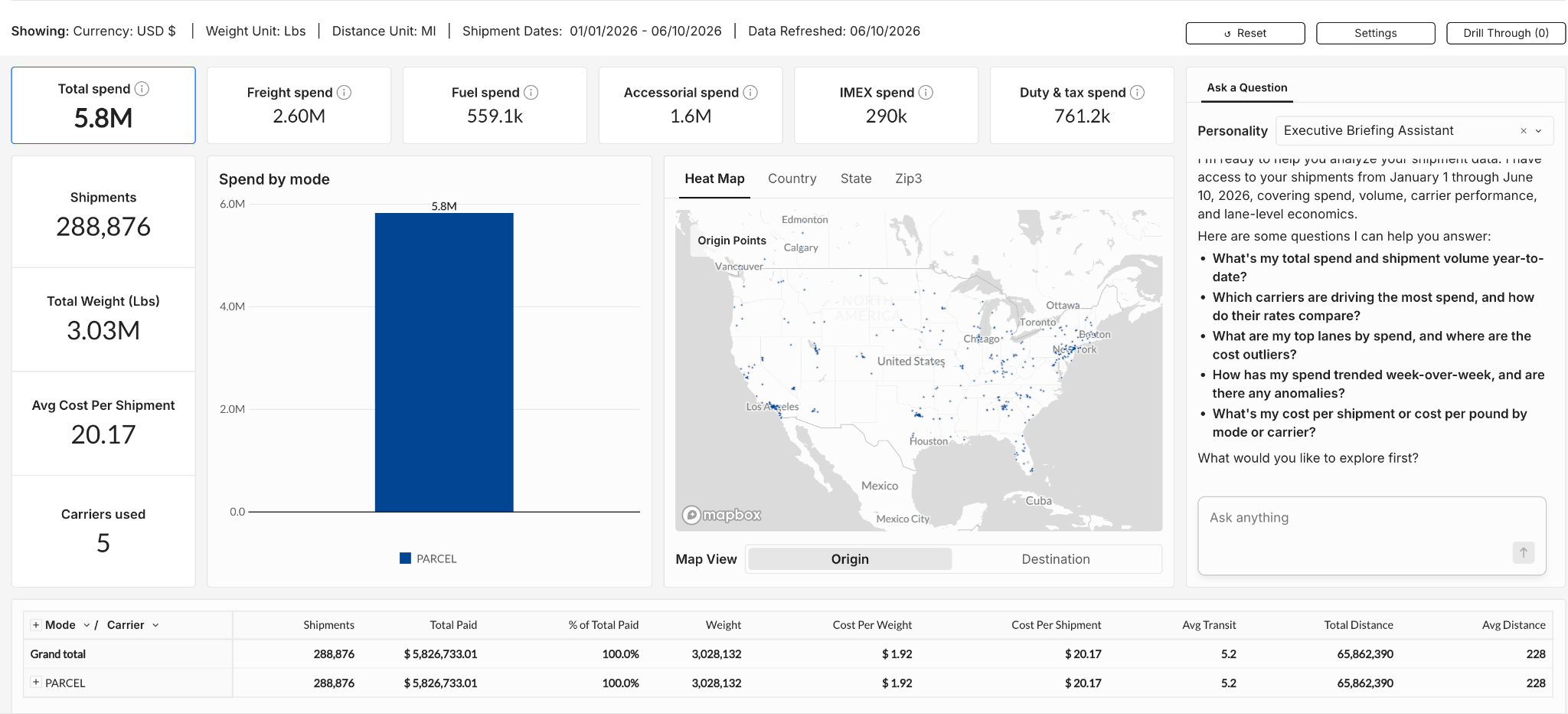
Loop Intelligence in action: $5.8M in freight spend, broken down by mode, carrier, and lane, with an embedded AI Assistant surfacing answers on demand.
No separate login or data export is required. Loop Intelligence lives inside the Loop Platform alongside your audit workflows, carrier data, and payment operations. The data powering your reports is the same data powering your audits, ensuring every insight is accurate, current, and consistent across your entire team.
Timely access to accurate data is the #1 data problem
Most logistics teams are sitting on more data than they know what to do with. The challenge is not a lack of data. It is access, timeliness, and usability.
Stale data forces bad decisions. Finance teams close books using estimates because actual freight costs are not available for 30 to 60 days after the fact. Carrier decisions get made on instinct because performance data lives in a spreadsheet someone updates once a month.
IT bottlenecks slow everything down. Every new report requires an IT ticket. Every customization becomes a multi-week project. By the time the data reaches operations and procurement, the window to act has already closed.
Fragmented systems produce conflicting numbers. Multiple reporting tools produce multiple versions of the truth. Teams debate data instead of acting on it. Carrier decisions get delayed. Strategic initiatives stall.
Loop Intelligence removes all three of those barriers at once. Loop Intelligence is one of three core pillars of the Loop Logistics Data Platform. The platform is powered by DUX 2.0, Loop's family of logistics-trained AI models and agents, which ensures every piece of data that enters Loop is extracted, normalized, validated, and linked before it reaches your dashboards.
Loop Intelligence improves financial clarity, carrier visibility, and team efficiency
Immediate financial clarity
Finance teams get line-item visibility into freight costs and billing accuracy, updated daily as invoices are validated and approved in audit. The 30 to 60 day reporting lag shrinks to a day, so books close faster, disputes resolve in hours rather than weeks, and every financial decision is grounded in validated actuals rather than estimates.
Accrual estimates are based on validated freight data rather than historical averages or manual guesswork, giving finance teams a more accurate and reliable foundation for month-end close.
Self-serve analytics for every team member
Loop Intelligence is built around a spreadsheet-like interface that any operations or finance professional can use without training. Users build reports, filter data, apply custom views, and explore insights without writing a line of code or filing a single IT ticket.
Customization that previously required months of engineering work now takes minutes. Reports refresh daily, stay available on demand, and are fully owned by the teams that use them.
Carrier performance, always visible
Carrier performance is kept current across your network, covering compliance rates, on-time performance, and overcharge trends. Under performers surface automatically, and trends become visible before they compound into costs.
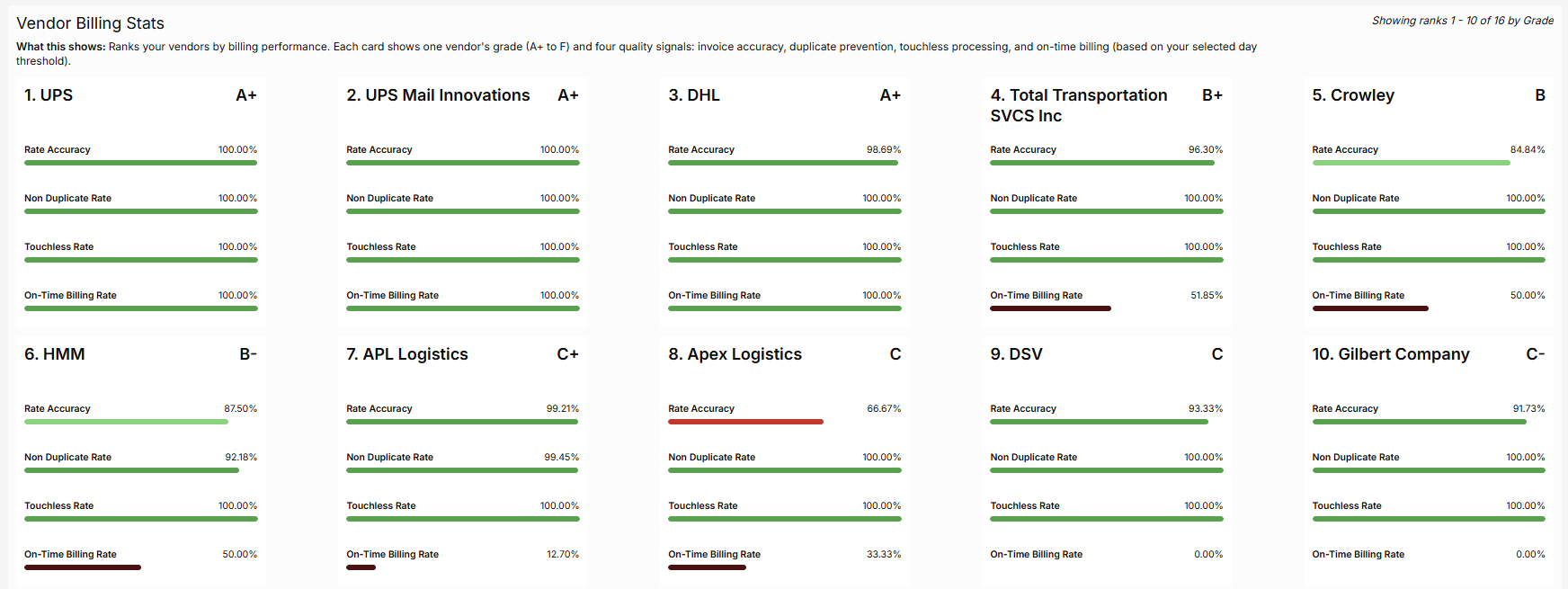
At the center of this is the upgraded Vendor Billing Scorecard, which takes a "video game stats" approach to carrier performance. Each carrier gets a report card with an A–F grade and four quality signals shown as visual progress bars:
Rate Accuracy — are they billing the right rates?
Non-Duplicate Rate — are they sending clean, unique invoices?
Touchless Rate — how often do invoices pass through without intervention?
On-Time Billing Rate — are they getting invoices in on time?
The grading system means anyone in ops, finance, or procurement can gauge vendor health at a glance without interpreting raw numbers. Green bars are good, dark red bars need attention, and the letter grade tells the story.
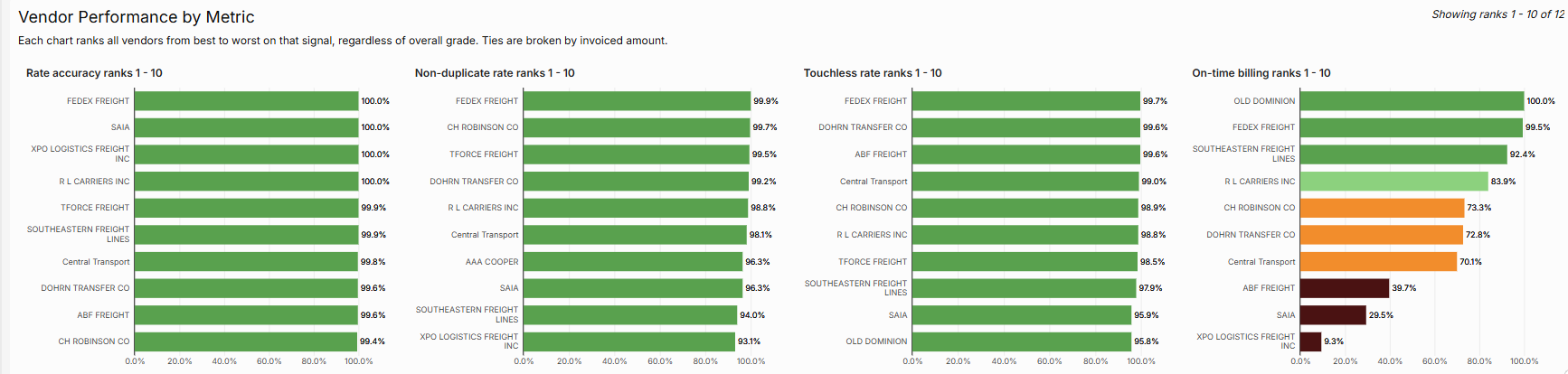
A companion Vendor Performance by Metric view ranks every vendor side by side on each signal independently, so you can quickly spot who leads and who lags on any single dimension.
Procurement leaders can use this data to negotiate contracts from a position of fact rather than instinct. Operations leaders use it to make routing decisions before problems escalate.
Key new features include AI Assistant and flexible alerts
Dashboards and reports
Loop Intelligence includes a suite of pre-built dashboards covering the most common analytics use cases in logistics:
Supply Chain Overview — total spend, shipment volumes, carrier count, and cost per shipment across all modes and vendors in one view.
Cost Categories — freight, fuel, accessorials, duty, and international spend broken down by carrier, mode, and month. Designed for finance teams that need line-item visibility for accruals, budgeting, and dispute resolution.
Carrier Performance and tracking — compliance rates, on-time performance, overcharge trends, and shipment-level delivery data across every carrier and mode. Designed for procurement, operations, and customer care teams that need both a strategic view of carrier performance and real-time visibility into individual shipments.
Trends— invoice auto-approval rates, days to approve, overcharge and undercharge trends, and freight exception counts by type. Designed for operations and finance teams that need to see how the freight operation is performing and where exceptions are stealing time.
The Intelligence AI Assistant
The AI Assistant is a natural language query interface built directly into Loop Intelligence. Users ask a question in plain English and receive an instant, data-backed answer from their logistics data
Questions the AI Assistant can answer include:
Which carriers had the highest overcharge rate last quarter?
What is my projected freight accrual for Q2?
How does my parcel spend break down by service level and carrier?
Which lanes are driving the most cost per shipment?
What accessorial charges have increased the most over the last 90 days?
The assistant does not require SQL, Python, or any technical knowledge. It is designed for the operations and finance professionals who need answers fast.
The AI Assistant queries the same validated dataset that powers every other Loop dashboard, so its answers stay consistent with your reports and reflect the same underlying data. It uses DUX 2.0's logistics domain knowledge to interpret questions correctly, understanding that a question about freight spend means carrier invoices and line-item charges, not warehouse costs or customs fees.
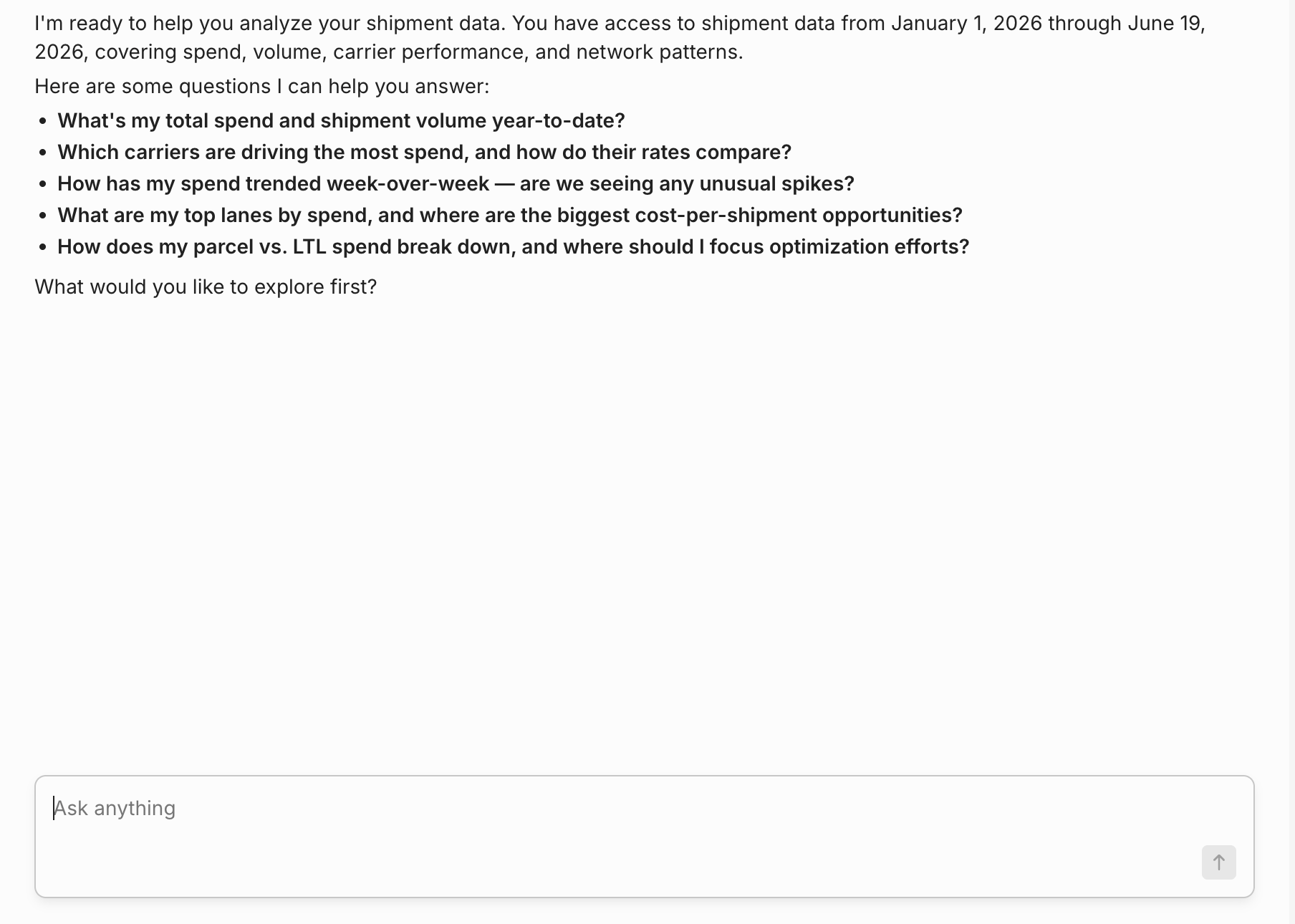
The Loop Intelligence AI Assistant, ready to answer questions about freight spend, carrier performance, and lane economics in plain English.
Alert Center
The Alert Center lets users configure automated notifications for any metric in Loop Intelligence. Set a threshold and a delivery schedule, and Loop sends an email alert when that threshold is crossed on the next data refresh.
For example, a procurement leader might set an alert for any carrier whose overcharge rate exceeds 5% in a rolling 30-day window. A finance leader might configure a weekly accrual summary delivered every Monday morning. An operations leader might set an alert for any lane where on-time performance drops below 90%.
Alerts are conditional and configurable. Your team gets notified only when something needs attention, not on a fixed schedule that floods inboxes with data no one has time to read.
Configure a scheduled export in Loop Intelligence: set the metric, the recipient, and the delivery format, and Loop handles the rest.
Custom report builder
Beyond the pre-built dashboards, Loop Intelligence includes a drag-and-drop report builder that allows any user to create fully customized reports without technical skills or IT involvement.
Reports can be filtered by mode, carrier, date range, cost category, lane, or any other dimension in your logistics data. Once built, reports are saved and reflect the most current numbers available. They can be shared with teammates or delivered automatically to your inbox on a schedule you set.
Get started with Loop Intelligence
Loop Intelligence is available to all Loop customers as part of the Logistics Data Platform. If you are already using Loop for freight audit, carrier payments, or parcel visibility, Loop Intelligence is already connected to your data.
If your team is still closing books on estimates, waiting on IT for reports, or making carrier decisions without current data, Loop Intelligence is ready to change that. Contact your account team to get started, or reach out to the Loop team to see a live demo.